
Introduction to Anger Management
This manual provides a research-based program designed to help individuals understand and effectively manage their anger. It outlines practical strategies and insights from clinical psychology to foster clearer thinking, improved relationships, and overall well-being.

Image: Front cover of the book, displaying the title and authors. This image illustrates the primary visual representation of the manual.
Core Concepts: Understanding Anger
Anger Basics
Anger is a normal human emotion. However, when it becomes chronic or leads to destructive behaviors, it requires management. This section clarifies the distinction between anger and aggression and addresses common questions about anger.
The Anger Episode Model
The manual introduces an enhanced 'Anger Episode Model' to help individuals analyze and understand the triggers, thoughts, feelings, and behaviors associated with their anger episodes. This model is crucial for identifying patterns and points of intervention.
Readiness for Change
Assessing one's readiness to change is a foundational step. The manual guides readers through evaluating their motivation and commitment to adopting new anger management skills.
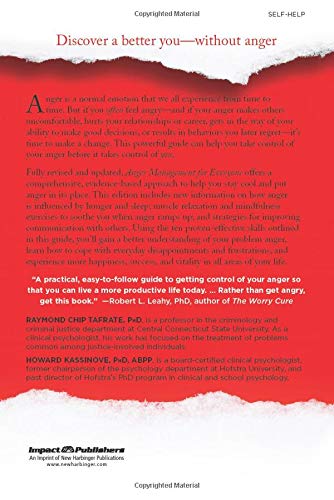
Image: Back cover of the book, featuring a summary of its content and endorsements. This image provides an overview of the book's key benefits and expert reviews.
Proven Strategies for Anger Management
The following strategies are designed to provide practical tools for controlling anger and improving emotional responses.
- Avoid and Escape: Learn to identify and strategically avoid or remove yourself from situations that predictably trigger anger. This involves proactive planning and recognizing early warning signs.
- Find New Solutions to Social Problems: Develop effective problem-solving skills to address interpersonal conflicts and frustrations that often lead to anger. This includes improving communication and negotiation.
- Change the Way You Think about Your Life (Cognitive Restructuring): Identify and challenge unhelpful thought patterns that fuel anger. This strategy focuses on reframing situations and developing more balanced perspectives.
- Forgiveness: Explore the process of forgiveness, both for others and for oneself, as a means to release resentment and reduce chronic anger. This is presented from a secular perspective.
- Learn to Relax: Implement relaxation techniques such as progressive muscle relaxation and mindfulness exercises to reduce physiological arousal associated with anger. Regular practice helps in managing immediate anger responses.
- Expose Yourself and Reach Less (Exposure Therapy): Gradually expose yourself to anger-provoking situations in a controlled manner to desensitize your reactions and build tolerance. This technique is best approached with careful planning.
- Express Your Anger in an Assertive, Productive Way: Develop assertive communication skills to express needs and feelings effectively without resorting to aggression or passive-aggression. This promotes healthier interactions.
Additional Guidance: Sustaining Progress
Addressing Persistent Anger
This section provides guidance on what to do if anger persists despite applying the strategies. It includes self-assessment tools and suggestions for seeking additional professional support if needed.
Cultivating a Happier Life
Beyond anger reduction, the manual offers steps to foster overall happiness, success, and vitality. This includes integrating positive psychology principles into daily life for long-term emotional well-being.
Тэхнічныя характарыстыкі прадукту
| Атрыбут | Дэталь |
|---|---|
| Выдавец | Ўздзеянне |
| Дата публікацыі | 2 студзеня 2019 г |
| Выданне | Second Edition, Revised |
| мова | англійская |
| Даўжыня друку | 256 старонак |
| ISBN-10 | 1684032261 |
| ISBN-13 | 978-1684032266 |
| Вага прадмета | 12.5 унцыі |
| Памеры | 6 х 0.55 х 9 цалі |
About the Authors and Publisher
Raymond Chip Tafrate PhD
Raymond Chip Tafrate, PhD, is a clinical psychologist and professor in the criminology and criminal justice department at Central Connecticut State University. He is a fellow and supervisor at the Albert Ellis Institute in New York City, NY, and a member of the Motivational Interviewing Network of Trainers. He frequently consults with criminal justice agencies and programs regarding difficult-to-change problems such as anger dysregulation and criminal behavior. He has coauthored numerous books, and has presented his research throughout North America, Europe, Asia, and Australia.
Howard Kassinove PhD ABPP
Howard Kassinove, PhD, ABPP, is a board-certified clinical psychologist, former chairperson of the psychology department at Hofstra University, and past director of their PhD program in clinical and school psychology. Kassinove is a fellow of the American Psychological Association, the American Psychological Society, the Albert Ellis Institute, and the Behavior Therapy and Research Society. The editor of Anger Disorders, he has published more than sixty papers, and has lectured widely in the United States, Europe, and Asia.
Matthew McKay PhD (Foreword)
Matthew McKay, PhD, is a professor at the Wright Institute in Berkeley, CA. He has authored and coauthored numerous books, including The Relaxation and Stress Reduction Workbook, Self-Esteem, Thoughts and Feelings, and more. McKay received his PhD in clinical psychology from the California School of Professional Psychology, and specializes in the cognitive behavioral treatment of anxiety and depression. He lives and works in the greater San Francisco Bay Area.
Publisher: Impact
Impact Publishers is dedicated to providing practical, evidence-based resources in psychology and self-help. They are known for publishing accessible and effective guides for personal growth and well-being.